
How Much Does a New Piano Cost in 2026?
A consumer’s guide to new piano prices, MSRP, and long-term value
So, you’ve decided to buy a new piano. Whether it’s for a child beginning lessons, a long-awaited addition to your home, or an upgrade from an older instrument, one question usually comes up early in the process: How much does a new piano actually cost?
The answer isn’t always straightforward. Manufacturer’s Suggested Retail Prices (MSRPs) don’t always reflect what customers ultimately pay. Promotional pricing can make it difficult to know what represents real value. And unlike many products, piano pricing often includes factors buyers don’t initially consider, such as preparation, inventory age, included services, delivery, and long-term support.
This guide explains the difference between MSRP and retail selling price, explores how piano size influences price, breaks down today’s piano price ranges, examines the factors that influence what buyers actually pay, and offers practical tips for comparing value from one dealer to another.
MSRP vs. retail selling price: Why piano prices can feel confusing
What is MSRP?
MSRP stands for Manufacturer’s Suggested Retail Price.
Think of MSRP as a benchmark rather than the price most customers ultimately pay. It gives buyers a way to compare instruments and categories, but it’s often not the number that appears on the final paperwork.
Most new pianos sell below MSRP depending on the brand, inventory situation, manufacturer incentives, and the services included with the purchase.
That said, some premium brands maintain more consistent pricing than others and may discount less frequently.
What is retail selling price?
Retail selling price is the amount a customer actually pays for a piano.
In simple terms, MSRP is the manufacturer’s suggested price, while retail selling price reflects the real-world purchase price.
That number can vary based on:
- Manufacturer promotions or financing incentives
- Dealer inventory levels
- Included preparation and services
- Market conditions
- Delivery, tuning, and long-term support
Why the difference matters
The best piano value isn’t always the least expensive instrument or the one advertised with the largest discount.
A lower price may include fewer services, less preparation, or limited long-term support. A higher price may include benefits that improve the ownership experience and long-term value.
The goal isn’t simply to find the lowest price. It’s to find a piano you genuinely love at a price that feels fair for the instrument, services, and support you receive.
How piano size influences price
One of the first ways shoppers compare piano prices is by size: Should I buy an upright, a baby grand, or a larger grand piano?
Size certainly influences price, but it’s only part of the story.
Larger pianos generally require more materials, more labor, and more physical space. They can also offer greater tonal depth, dynamic range, and projection, which often contributes to a higher price.
That said, craftsmanship, materials, performance level, preparation, cabinet finish, and overall build quality can affect cost just as much—or more.
For example, a smaller handcrafted grand piano may cost considerably more than a larger entry-level model. Likewise, a high-quality upright may outperform a lower-grade grand piano depending on how it is designed, built, and prepared.
While larger pianos often command higher prices, size alone doesn’t determine value.
Size helps establish expectations. Overall quality ultimately determines value.
2026 new piano price ranges (simplified market guide)
The categories below are simplified groupings intended to help compare broad pricing tiers across today’s market. They are not universal industry standards, and actual pricing varies by brand, finish, preparation, and included services.
These ranges provide a framework—not a rulebook—but they can help narrow expectations before you begin shopping.
Grand piano price ranges
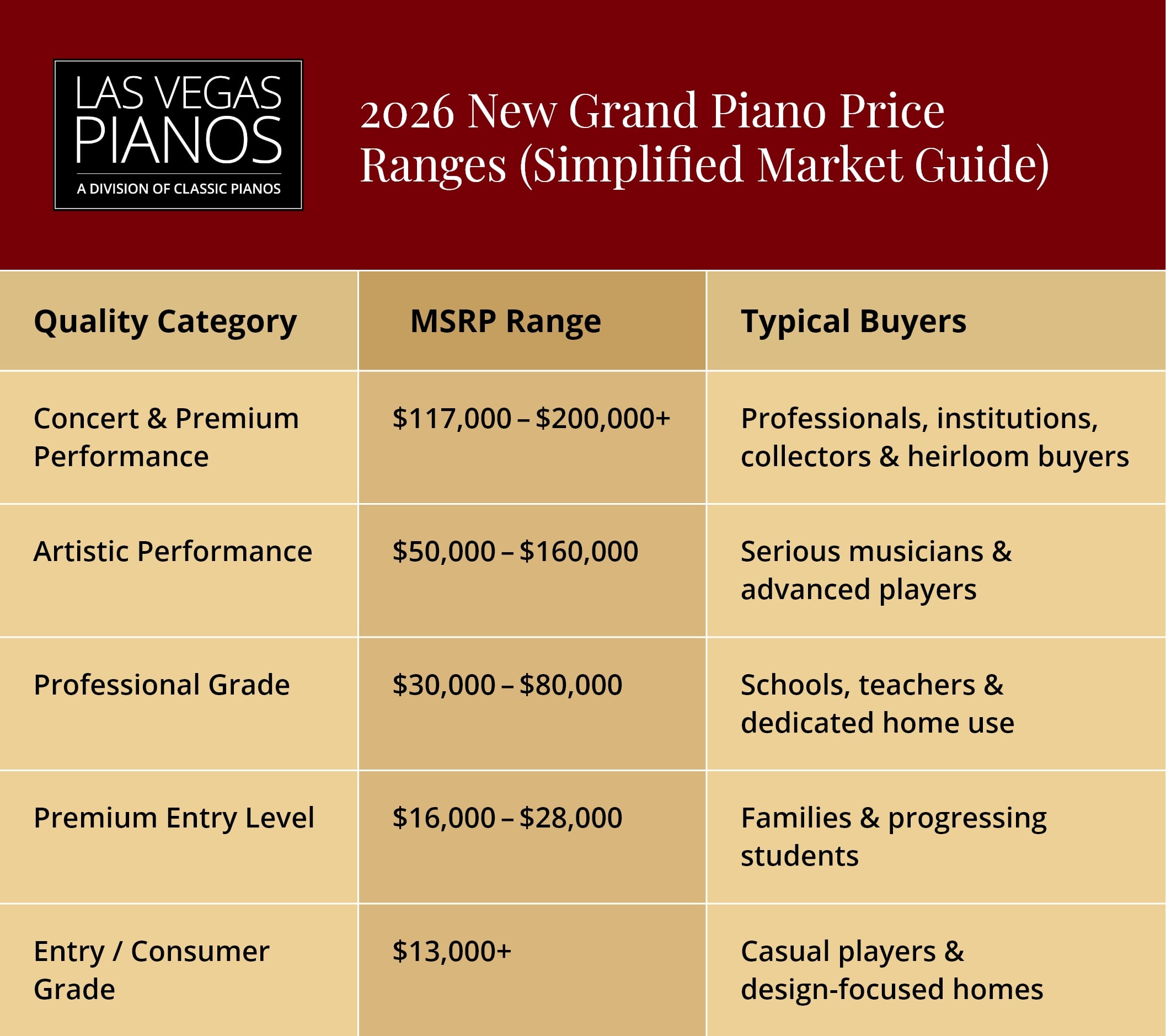
| Quality Category | MSRP Range | Typical Buyers |
|---|---|---|
| Concert and Premium Performance | 117000 dollars to 200000 dollars and up | Professionals institutions collectors and heirloom buyers |
| Artistic Performance | 50000 dollars to 160000 dollars | Serious musicians and advanced players |
| Professional Grade | 30000 dollars to 80000 dollars | Schools teachers and dedicated home use |
| Premium Entry Level | 16000 dollars to 28000 dollars | Families and progressing students |
| Entry and Consumer Grade | 13000 dollars and up | Casual players and design focused homes |
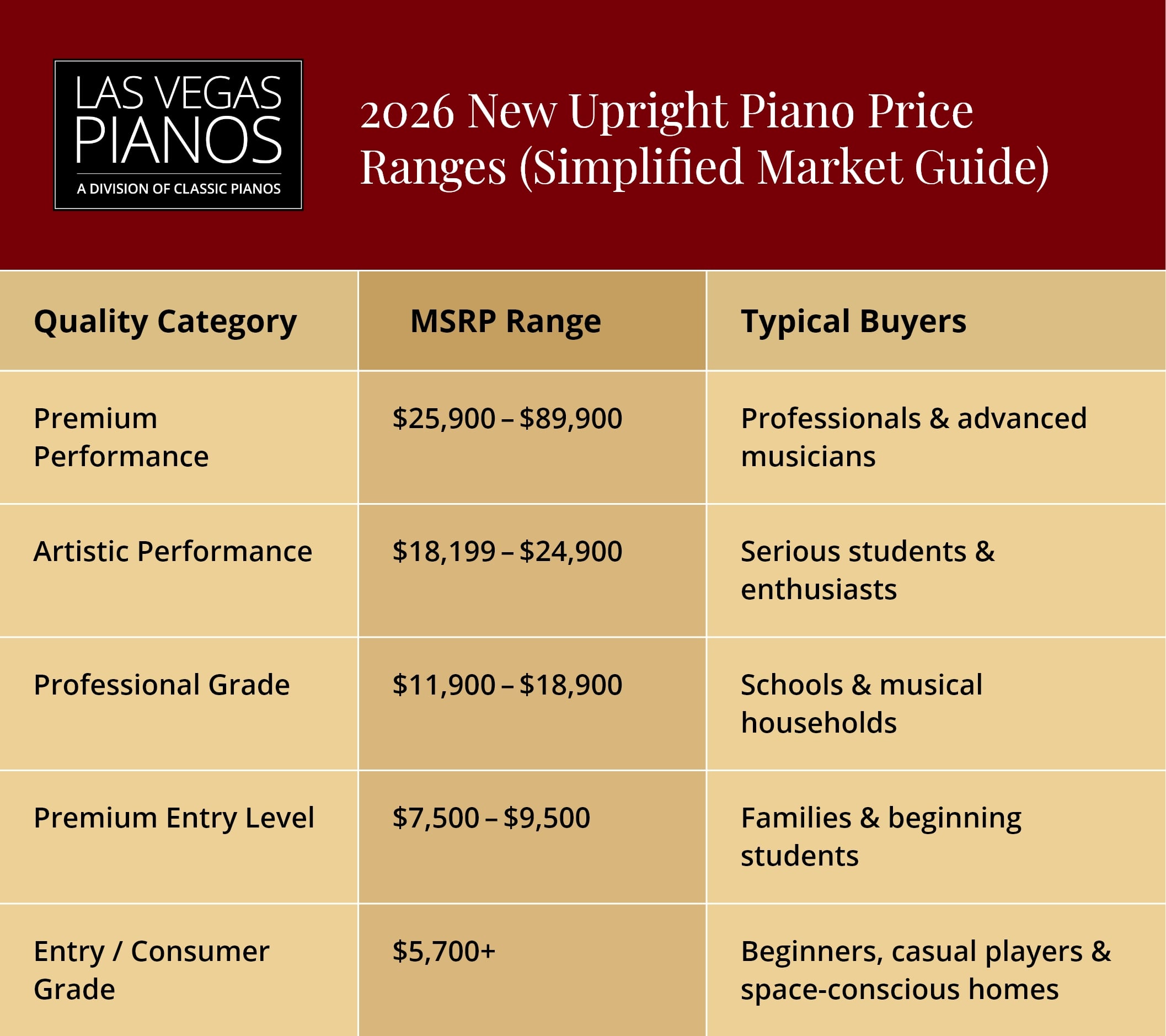
Upright piano price ranges
As you review these ranges, remember that two pianos with similar dimensions can have dramatically different prices. Design, materials, craftsmanship, preparation, brand reputation, and long-term support often influence value just as much as size.
| Quality Category | MSRP Range | Typical Buyers |
|---|---|---|
| Premium Performance | 25900 dollars to 89900 dollars | Professionals and advanced musicians |
| Artistic Performance | 18199 dollars to 24900 dollars | Serious students and enthusiasts |
| Professional Grade | 11900 dollars to 18900 dollars | Schools and musical households |
| Premium Entry Level | 7500 dollars to 9500 dollars | Families and beginning students |
| Entry and Consumer Grade | 5700 dollars and up | Beginners casual players and space conscious homes |
What affects the price you actually pay for a piano?
The price ranges above provide a helpful starting point, but they don’t tell the whole story. Two pianos with similar dimensions—or even similar MSRPs—can have very different selling prices depending on a variety of factors. Understanding those factors can help you compare value more effectively and avoid focusing exclusively on the sticker price.
Dealer pricing philosophy
Every piano dealer approaches pricing differently.
Some dealers focus on lower margins and higher sales volume. Others rely more heavily on promotional events, manufacturer programs, or specialty inventory opportunities.
Neither approach automatically means better or worse value, but it can influence what buyers ultimately pay and what services are included with the purchase.
Manufacturer incentives and promotions
Manufacturers occasionally support sales through rebates, special financing offers, partnership programs, or limited-time promotions.
In some cases, these incentives result in a lower selling price. In others, the value may come through attractive financing terms or services included with the purchase.
Because manufacturer programs change throughout the year, the same piano may be offered under different terms at different times.
Inventory age
Like many retail businesses, piano dealers manage inventory over time.
If an instrument remains on the showroom floor for an extended period, there may occasionally be more flexibility in pricing. This can create opportunities for buyers, particularly if the piano has been well maintained, properly prepared, and cared for while on display.
Preparation and service standards
A new piano is rarely simply unboxed and delivered.
Many instruments require inspection, regulation, tuning, voicing, and final preparation before reaching their full potential. The amount of preparation and support included can vary from one dealer to another.
This is one of the reasons two similar pianos may carry different selling prices. A lower price may include less preparation or fewer services, while a higher price may reflect additional technical work, delivery support, follow-up tuning, or other services designed to help the piano perform at its best.
When comparing offers, it’s important to understand not only the piano itself, but also the preparation, service, and support included before and after delivery.
5 ways to get strong value when buying a new piano
Understanding what affects piano pricing is important. The next step is knowing how to evaluate value—not just price—when comparing your options.
These tips can help you look beyond the sticker price and focus on the factors that matter most over the life of the instrument.
1. Be honest about your budget
Being open about your budget can help narrow the field more quickly and focus the conversation on instruments that fit your goals.
It can also help you to account for other costs such as delivery, taxes, accessories, and long-term ownership considerations.
2. Ask what’s included
Two similar-looking pianos may come with very different levels of preparation, service, and support. Be sure to ask:
- Is preparation included?
- Are follow-up tunings offered?
- What service support exists after delivery?
- Is there a trade-up policy?
3. Research the dealer’s reputation
A piano is often a long-term purchase, and the relationship with the dealer doesn’t necessarily end when the piano is delivered.
Reviews, service departments, technical expertise, community involvement, and long-term customer satisfaction can all be worth considering.
4. Compare total ownership value—not just price
The least expensive instrument upfront may not always provide the strongest long-term experience.
When comparing offers, consider preparation, service, warranty support, trade-up opportunities, and ongoing care—not just the initial selling price.
5. Ask about value-added options
If a lower selling price isn’t available, there may be other ways to improve the overall value of the purchase.
Depending on the piano and the current promotion, that could include upgraded benches, follow-up tuning, free delivery, extended service, or improved trade-up benefits.
Visit Las Vegas Pianos to compare pianos in person
Reading about piano pricing is a great starting point, but comparing instruments in person is the best way to understand the differences between brands, sizes, performance levels, and overall value.
You may discover that the piano you expected to love isn’t the one you ultimately choose—and that’s part of what makes shopping in person valuable.
Whether you’re shopping for your first piano, upgrading to a larger instrument, or exploring options within a specific budget, our team can help you compare choices and answer questions in a relaxed, no-pressure environment.
We invite you to visit Las Vegas Pianos at 6295 McLeod Drive #20 to explore our selection of grand pianos, upright pianos, and digital pianos and experience them for yourself.
Questions before you visit? Call 702-452-2400 to talk with our team. We’re happy to help.
Frequently asked questions about new piano prices
Are new piano prices negotiable?
In many cases, yes. However, pricing flexibility varies by brand, dealer, inventory situation, manufacturer promotions, and the services included with the purchase.
Rather than focusing solely on the discount, it’s often helpful to understand the overall value being offered, including preparation, delivery, service, warranty support, and other benefits that may be included.
Why do piano prices vary between dealers?
Several factors can influence pricing, including dealer inventory levels, manufacturer incentives, preparation standards, included services, delivery policies, and long-term support.
When comparing prices, it’s important to understand what is included with the purchase, not just the selling price itself.
What services are typically included with a new piano purchase?
In many cases, a new piano purchase includes professional preparation before delivery, such as inspection, regulation, tuning, voicing, and final adjustments. Many dealers also include at least one follow-up tuning after the piano has adjusted to its new environment.
Because preparation and service policies vary from one dealer to another, it’s a good idea to ask what work has been completed before delivery and what post-delivery support is included with your purchase.
Are there additional fees beyond the quoted price?
There can be. Depending on the dealer and the delivery situation, there may be charges for delivery, difficult-access moves, extended distances, or other special circumstances. Be sure to ask for a complete understanding of any costs before making a final decision.
Do dealers offer price-match or value guarantees?
Policies vary from one dealer to another. Some dealers offer price-match programs or value guarantees, while others focus on competitive everyday pricing and service. If you’re comparing offers, ask what is included and whether the dealer has a policy regarding competitive pricing.
Are there discounts for paying cash?
Some dealers may offer incentives for certain payment methods, while others may have manufacturer financing programs or promotional terms that provide greater overall value. The best approach is to ask about all available options and compare the total value of each offer.
Does the country where a piano is made affect the price?
Often, yes. Manufacturing methods, labor costs, materials, production volume, and brand heritage can all influence price.
While country of origin is only one factor, instruments built in countries with long traditions of piano craftsmanship—such as Germany (Schimmel), Austria (Bösendorfer), Estonia, Japan (Yamaha), and the United States—often occupy higher price categories. At the same time, many pianos built in China, Indonesia, and other countries can offer excellent value depending on the brand, design, and level of preparation.