
Are Portable Keyboards Good for Beginner Piano Lessons? What Parents Should Know Before Buying
Few things bring more joy to a family than introducing music into a child’s life. For many families, that journey begins with piano lessons.
Learning piano can help children build focus, discipline, coordination, confidence, and emotional expression. It also gives them a meaningful way to experience music, creativity, and personal achievement.
Naturally, one of the first questions parents ask is:
Do we need a real piano, or is a portable keyboard good enough for piano lessons?
In many cases, a portable keyboard can work as a short-term starting point—but it may not provide the touch, sound, or control needed for long-term progress.
Portable keyboards can seem like a practical place to start. They are small, easy to move, and often more affordable than acoustic or digital pianos. For parents who are not yet sure if their child will continue with lessons, a portable keyboard may feel like a low-risk option.
But there is a more important question to consider:
Will a portable keyboard give a beginner the touch, tone, and musical experience needed to learn properly and stay inspired?
This article looks at that question fairly, focusing on what helps beginning students build strong skills from the start.
Why weighted keys matter for piano lessons
One of the biggest differences between most portable keyboards and acoustic and digital pianos is the touch response. It is hard to overstate how critical this is, especially for beginners.
Most portable keyboards use light, spring-action keys, while an acoustic or quality digital piano uses a weighted action that offers resistance and control.
It’s a difference that matters.
From the very start, students develop finger strength, control, and sensitivity through touch. How the piano feels—and whether they can play at different volumes—is a fundamental part of the learning process.
This is why most experienced teachers emphasize the importance of touch. It’s an essential element in moving from simply playing the right notes to creating music.
Without the right touch response, students can miss a key part of that development.
Why sound quality matters when learning piano
Learning to play the piano isn’t just about pressing the correct keys.
It’s also about learning to listen—and to listen critically.
A portable keyboard can certainly produce a pleasant sound, and for some beginners, that may seem like enough to get started. But does it offer the range of tone, depth, and responsiveness that helps a student stay engaged over time?
Most portable keyboards use smaller speakers and simpler sound sampling, which can limit both tone and volume. While every student hears differently, many teachers find that instruments with greater tonal richness and dynamic control make practice more rewarding.
Students respond to what they hear. When an instrument offers more depth and variation in sound, it gives them more to listen for, respond to, and grow into.
By comparison, portable keyboards aren’t designed to provide the same level of musical feedback or expression as an acoustic or quality digital piano.
Why pedals matter for piano lessons
It may be surprising to hear, but the pedals on a piano play an important role in how music sounds and feels.
They control sustain, tone, and expression—and are often described as the “window of sound.”
Most portable keyboards include a simple sustain switch that sits on the floor. While it serves a purpose, it’s not the same as learning on a piano with fully functioning pedals that offer realistic control and response.
Using proper pedals is part of learning how to shape sound and create musical phrasing. It’s not something that comes later—it’s part of the foundation.
Without that experience, students can miss an important aspect of how the piano is meant to be played.
Many students outgrow basic keyboards quickly
Over the years, we’ve worked with many families who began with entry-level keyboards and later upgraded once lessons became more serious. A portable keyboard can seem “good enough for now,” especially in the early stages.
But in many cases, the limitations become noticeable fairly quickly.
As students become more engaged, they often need more from the instrument—better touch response, greater control, and a fuller range of sound. At that point, a basic keyboard can begin to feel limiting rather than supportive.
This is often when families realize they need an instrument designed to grow with the student, rather than one intended primarily for short-term use.
Acoustic and quality digital pianos are built to support long-term development from the beginning.
Consider these better options
While many teachers still recommend starting on an acoustic piano, there are also excellent digital options available today.
Quality digital pianos have come a long way. Many offer:
- Fully weighted, 88-key keyboards
- Pedals that more closely replicate an acoustic piano
- High-quality sound sampling from well-known concert grands
They’re designed to provide a more realistic playing experience while still being practical for a variety of homes.
For families who are exploring ways to get started without a significant upfront investment, there are often more options than expected. Rental programs, well-prepared used pianos, and monthly payment plans can make a higher-quality instrument more accessible.
For those who need additional flexibility, hybrid or “silent” pianos offer the touch of an acoustic instrument with the ability to play using headphones.
For a deeper look at how digital, acoustic (& hybrid) pianos compare, you can read our guide.
For many beginners, a quality acoustic piano remains an excellent choice. At the same time, there’s often more than one good path forward depending on space, budget, and long-term goals.
Start with the end in mind
Hardly a week goes by without us hearing adults say, “I wish I had continued my lessons.”
It’s a simple comment, but it comes up often—and it points to something important.
The question may not be:
“What is the least expensive way to begin?”
Instead, it may be:
“What gives a beginner the best chance to succeed—and stay engaged over time?”
Every family or beginning adult has to consider budget, space, and long-term goals. But the instrument someone starts on can play a meaningful role in whether they continue.
Portable keyboard vs. piano: What’s the difference?
Here’s a simple way to compare how portable keyboards stack up against acoustic and quality digital pianos:
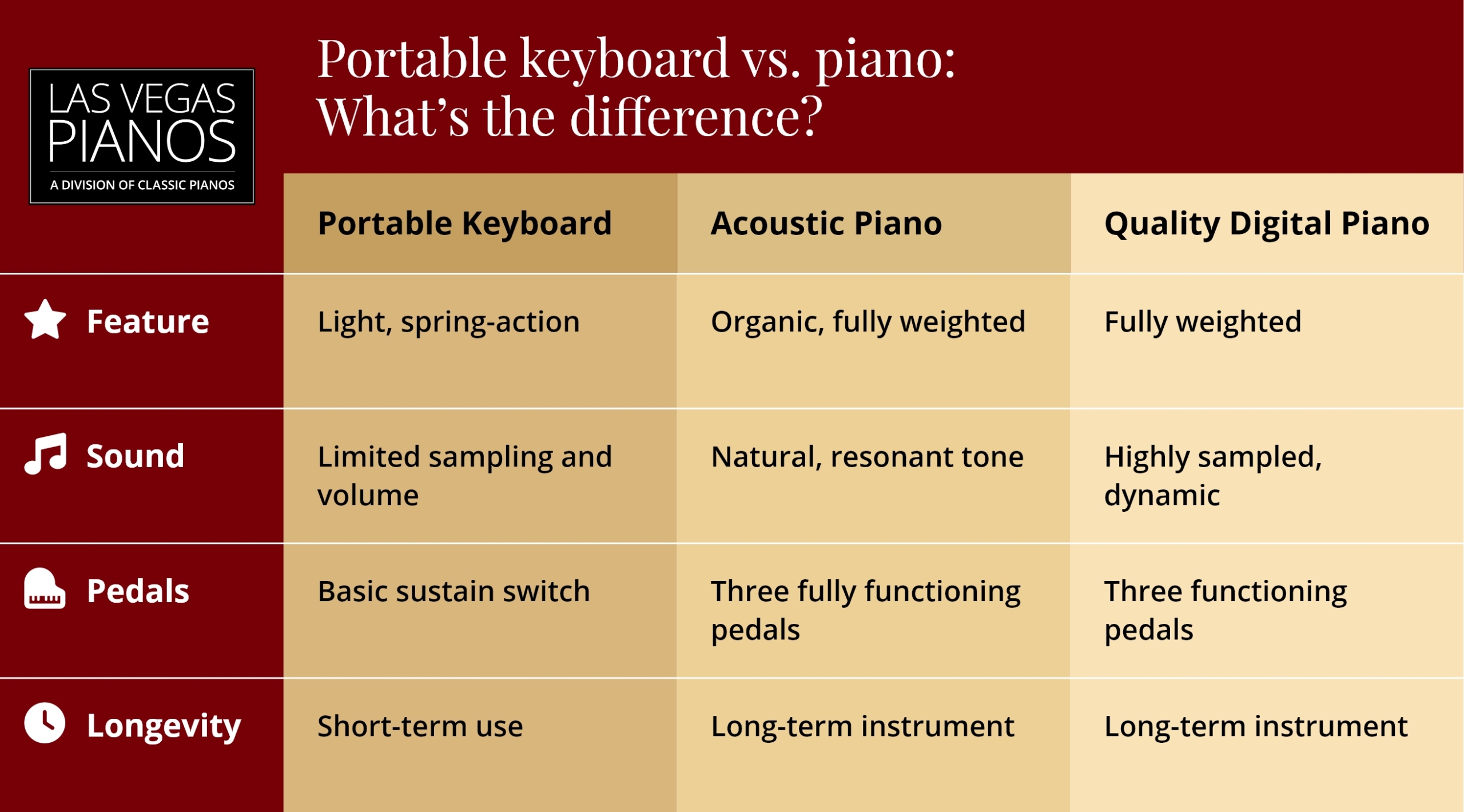
| Category | Portable Keyboard | Acoustic Piano | Quality Digital Piano |
|---|---|---|---|
| Feature | Light, spring action | Organic, fully weighted | Fully weighted |
| Sound | Limited sampling and volume | Natural, resonant tone | Highly sampled, dynamic |
| Pedals | Basic sustain switch | Three fully functioning pedals | Three functioning pedals |
| Longevity | Short term use | Long term instrument | Long term instrument |
So, is it possible to start on a portable keyboard?
In some cases, yes.
There are always exceptions, and for families working within a tighter budget, a portable keyboard can be a practical short-term starting point.
That said, it’s important to understand its limitations. Not all keyboards are created equal, and entry-level models are not designed to support long-term development.
If starting with a portable keyboard, it’s worth looking for a higher-quality model from a well-established maker like Yamaha—something designed to serve as a transitional instrument rather than a long-term solution.
As lessons progress, many students eventually benefit from moving to an instrument with weighted keys, realistic touch response, and proper pedal functionality.
What about high-end keyboards?
It’s worth noting that there are high-end keyboards used by professional musicians in performance and recording settings.
These instruments can be powerful and, in some cases, just as expensive as quality digital or even acoustic pianos. They’re designed for versatility, sound layering, and portability in live or studio environments.
But they serve a different purpose.
For beginning piano students, these types of keyboards typically aren’t the right starting point—especially when it comes to developing proper touch, technique, and control.
Choosing the right first piano
Many teachers find that instruments with proper touch, tone, and pedal response make learning easier, more rewarding, and more engaging.
A beginner’s first piano needs to do more than simply produce notes. It should help students develop control, confidence, and musical expression from the very beginning.
And while every family’s situation is different, starting with the right instrument often gives beginners the best chance to stay inspired and continue growing over time.
If you’re unsure where to start, visiting a showroom and spending time with different pianos can make a tremendous difference. Hearing and feeling the difference in person often gives beginners and families far more confidence in the decision-making process.
Get expert piano guidance from Las Vegas Pianos
At Las Vegas Pianos, we’ve helped thousands of beginners, families, teachers, and experienced pianists choose the right instrument for their goals, space, and musical journey.
If you’re starting the process and would like honest, experienced guidance, our team is happy to help you compare options and better understand what to look for in a first piano.
Stop into the showroom at 6295 McLeod Drive #20 in Las Vegas, give us a call at 702-452-2400, or contact us to explore the role the right piano can play in long-term musical growth and enjoyment.
Frequently Asked Questions About Portable Keyboards for Piano Lessons
Are portable keyboards good for beginners?
Portable keyboards can be a starting point, especially for families looking for a lower-cost option. However, many don’t offer the touch response, sound quality, or pedal functionality that supports proper piano technique. For beginners who want to build strong skills, a keyboard with fully weighted keys is typically recommended.
Can you learn piano on a keyboard instead of a piano?
It’s possible to learn basic skills on a keyboard, but not all keyboards are designed for piano study. Instruments without weighted keys and proper touch response can make it more difficult to develop control, dynamics, and technique over time.
Is a 61-key keyboard enough for piano lessons?
A 61-key keyboard can work in the very early stages, but most students will outgrow it quickly. Piano teachers generally recommend starting with an 88-key instrument, so students have access to the full range as they progress.
Do piano teachers recommend portable keyboards?
Some teachers are open to students starting on a keyboard, but most recommend a digital or acoustic piano with weighted keys. The goal is to give students an experience that supports proper technique from the start.
What is the best keyboard for piano students?
For students taking piano lessons, a digital piano with 88 weighted keys, realistic touch response, and proper pedals is typically the best option. These instruments are designed to replicate the feel and sound of an acoustic piano while still being practical for home use.